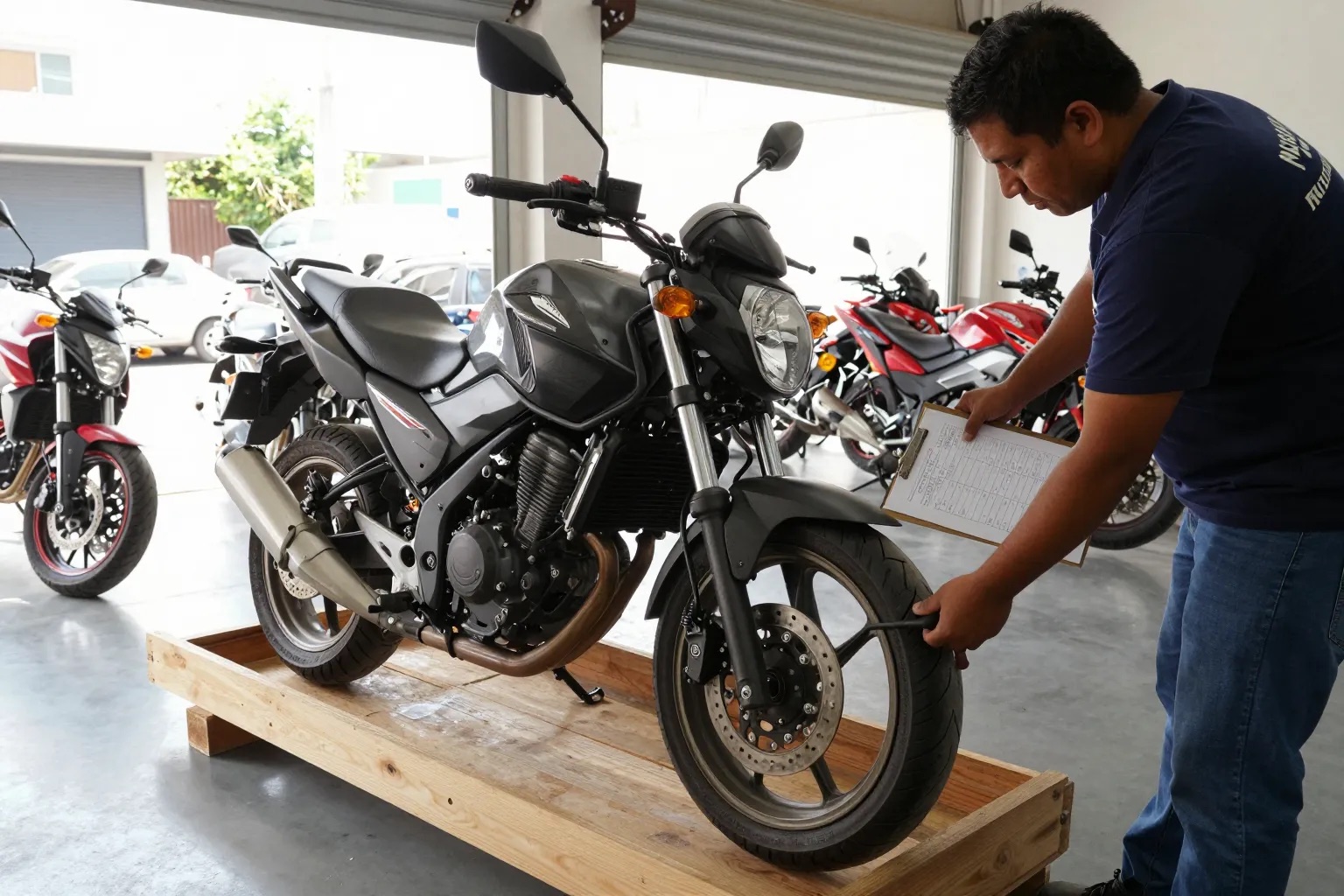
Every few weeks a dealer asks whether shipping bikes as kits would cut duty or fit more units in the box. Sometimes yes. More often the saving is real on paper and disappears in labour, tooling, homologation paperwork and one missing bolt bag. Here is how to decide with numbers instead of hope.
Three ways a motorcycle can leave China
| CBU | SKD | CKD | |
|---|---|---|---|
| Arrives as | Complete bike, front wheel/handlebar/mirrors removed for crating | Painted frame with engine fitted; wheels, forks, bodywork, harness packed alongside | Loose components, often engine and frame from different suppliers; requires jigs |
| Dealer work per unit | 30–60 minutes | 3–6 hours by a trained mechanic | Assembly line, 10–20 hours plus QC |
| Container density (40HQ, 150cc commuter) | 30–34 | 45–55 | 70–90 (component-dependent) |
| Homologation | Factory documents cover the bike as shipped | Usually still covered, some registries require assembler declaration | You become the manufacturer of record in most registries |
| Factory MOQ | 3 per model (through us) | 20–50 per model typically | 100+ per model, usually 500+ |
Where the duty really differs
Customs classification follows the Harmonized System. Under General Interpretative Rule 2(a), an unassembled article that has the essential character of the complete article is classified as the complete article. That means many customs offices treat an SKD bike as a CBU bike unless the national schedule creates a separate kit line. The markets in our country profiles where the kit line matters:
- Colombia. Assembled motorcycles carry roughly 15% MFN duty; CKD kits for local assembly attract lower rates, which is why AKT and Auteco assemble domestically. A dealer importing 20 units cannot use this; an assembler with a registered plant can.
- Nigeria. Assembled bikes around 20%, CKD around 5% under the ECOWAS schedule. Local assembly is the dominant model, again at plant scale.
- Kenya. EAC common external tariff: assembled about 25%, CKD about 10%, tied to registered assemblers.
- Ecuador. Assembly incentives exist and the China FTA phases assembled-bike duty down over years; the gap is closing, which weakens the case for kits.
Rates above are the planning defaults from our profiles, last reviewed September 2026, and must be confirmed with a licensed broker for the exact subheading. Kit lines are frequently restricted to licensed assemblers, so the rate you read may not be the rate you can use.
The density gain is real, the labour is not free
Take 40 commuters. As CBU they need slightly more than one 40HQ; as SKD they fit in one with space left for parts. Ocean freight saving: perhaps US$1,500–2,500. Assembly at 4 hours per unit at a realistic workshop rate of US$8–15 per hour: US$1,300–2,400, plus a set of torque wrenches, a wheel-truing stand, fork oil, a battery charger bank, and one mechanic who has done it before. If you already run a service workshop the maths can work. If you would be hiring for it, it does not.
Homologation is the quiet cost
Registries that accept a factory conformity document for a CBU bike often want an assembler declaration for SKD, and treat CKD as local manufacture, with a new VIN assignment and a type-approval file that is yours to build. In markets like Chile (3CV) or Ecuador (INEN) that is a project, not a form. Ask your registry before you ask the factory.
Our rule of thumb
- Below roughly 100 units a year of one model: stay CBU. Use the mixed container to test segments.
- 100–500 units of one model, with a workshop and a kit tariff line you have confirmed in writing: SKD can pay. We arrange it, MOQ from the factory is usually 20–50 per model.
- Above that, you are looking at a CKD assembly agreement with a factory directly, and we will say so and introduce you.
FAQ
What is the difference between SKD and CKD?
SKD (semi knock-down) ships major sub-assemblies already built: the engine is complete, the frame is welded and painted, wheels are laced, and the dealer fits wheels, handlebar, bodywork and fluids. CKD (complete knock-down) ships components for a real assembly line: loose engines, frames, harnesses, plastics, often with local content requirements. SKD is a bigger crate of an almost-finished bike; CKD is a factory in boxes.
Can I import SKD to save duty in my country?
Only if your tariff schedule has a separate, lower line for kits and your customs accepts the kit as a kit rather than a disassembled CBU. Colombia, Nigeria and Kenya have such lines; many countries do not, and some explicitly classify SKD as CBU. Check the subheading with your broker before ordering.
How many more bikes fit a container as SKD?
Roughly 40–60% more for commuters when the front wheel, handlebar and bodywork are packed flat: a 40HQ that carries 30–34 crated CBU commuters can take 45–55 SKD kits. Big enduros gain less because the engine and frame still dominate the crate.
Does the factory PDI still apply to SKD?
The engine is started on a test bench and the electrics checked, but the road-test part of the PDI happens at your end after assembly. Our PDI video for SKD covers engine run, electrics and a full parts count against the packing list.
Sources
Yangtze Moto is an independent export company based in Chongqing. We are not a manufacturer and are not affiliated with or endorsed by any motorcycle brand mentioned for reference, including ZXMOTO (Zhang Xue Moto), KOVE, VOGE, Zongshen, Loncin, Lifan and KEWS. All trademarks belong to their respective owners. FOB bands are indicative market figures observed in supplier quotations (July–September 2026); allocation-based models carry no published export price. Every order is quoted line by line before you commit.
← All guides · Buyer’s hub · Templates