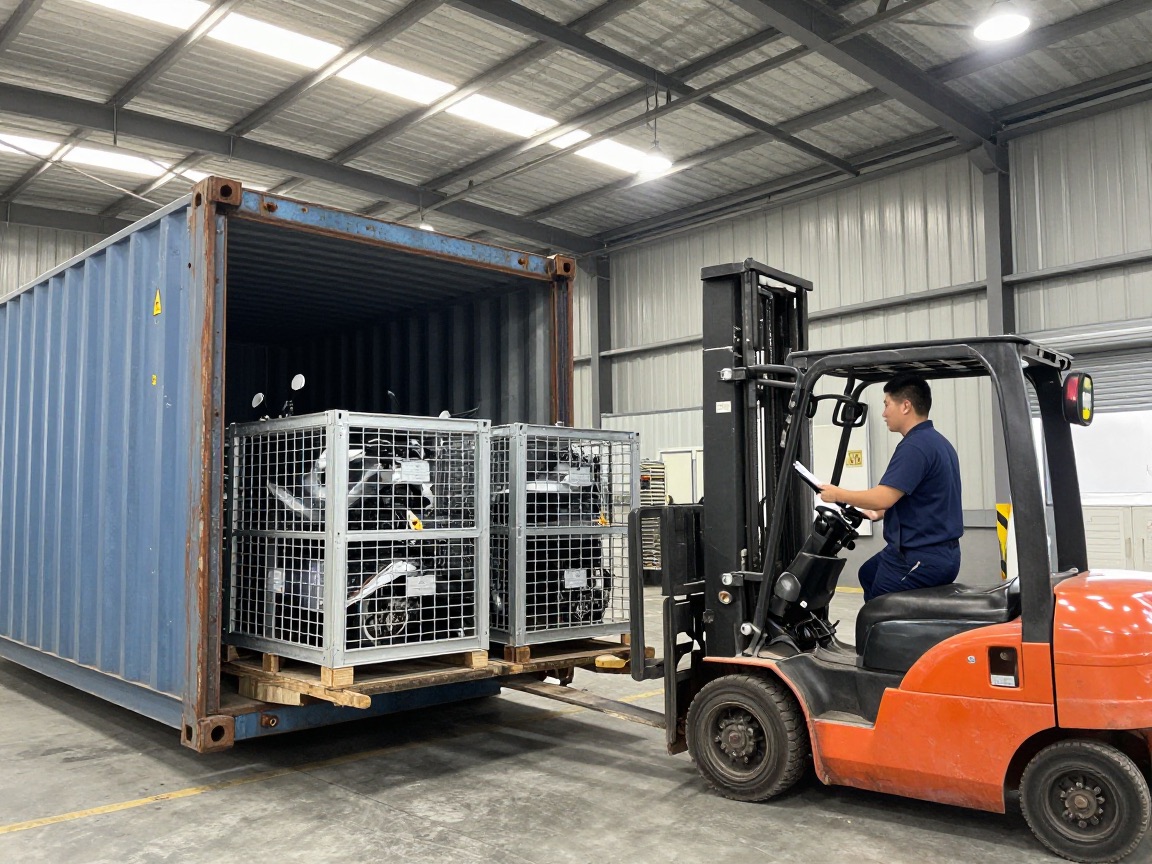
Every quote you receive for a container of motorcycles carries a three-letter word that decides who pays the freight, who carries the risk if the ship has a bad week, and who argues with customs. Get the term right and the rest of the price comparison becomes honest. Get it wrong and a “cheaper” CIF offer can cost more than an FOB one.
The six terms you will actually meet
| Term | Seller delivers… | Who pays what | Risk transfers | Our take for motorcycles |
|---|---|---|---|---|
| EXW | Factory gate, Chongqing | You: export clearance, inland to port, ocean, insurance, import | At the factory door | Only if you have your own China forwarder and export licence — rare for dealers |
| FOB | On board the vessel, Chinese port | Seller: inland, export clearance, loading. You: ocean freight, insurance, import | When the crates cross the ship’s rail | The standard we quote — you control the ocean leg and the price is comparable across suppliers |
| CFR | On board, freight paid to destination port | Seller: as FOB + ocean freight. You: insurance, import | Same as FOB (at loading), even though seller pays freight | Convenient, but you carry transit risk without choosing the insurer |
| CIF | On board, freight + minimum insurance paid | Seller: as CFR + basic marine insurance. You: import | At loading; insurance only covers minimum (Clause C) unless upgraded | Good for first-timers with no forwarder; ask for Clause A cover |
| DAP | Delivered at named place, not cleared | Seller: everything to your city, unloaded excluded. You: duty, VAT, clearance | At the named place | Only sensible where seller has a strong local agent |
| DDP | Delivered, duty paid | Seller: everything incl. duty and VAT | At delivery | Seller must be registered importer in your country; almost never for motorcycles |
Why FOB is the right default
Under FOB the seller does the part it is good at (getting crates from Chongqing factories to a Chinese port and through export customs) and you do the part you should control (choosing the carrier, the transit time and the insurer). Three practical benefits:
- Comparable quotes. Two FOB prices for the same model are directly comparable. Two CIF prices are not, because each hides a different freight rate and insurance clause.
- You choose the forwarder. A forwarder at your end knows your port, your broker and your customs quirks. Under CIF the seller’s forwarder hands the cargo to an agent you have never spoken to.
- Insurance you actually want. CIF only obliges the seller to buy minimum cover (Institute Cargo Clauses C). Motorcycles are theft-attractive and crate damage is common; you want Clause A, all-risks, which you can buy for around 0.3–0.6% of CIF value.
When CIF makes sense
If this is your first container, you do not have a forwarder relationship, and the port is a main line (Jebel Ali, Callao, Manzanillo, Mombasa), CIF removes a coordination task. Ask three things: the carrier name, the insurance clause (insist on A), and the freight rate broken out on the invoice so you can compare next time. On repeat orders move to FOB.
Where risk really transfers
Under FOB, CFR and CIF the risk passes to you when the crates are loaded on board in China, regardless of who paid the freight. That is why loading photos and the container seal number in the loading report matter: they are your evidence that the goods were sound when your risk began. Anything discovered at destination is a claim against the insurer or the carrier, not the factory, unless the PDI evidence shows the defect existed before crating.
Worked example: 20GP of 12 bikes, FOB vs CIF
| Line | FOB route | CIF offer |
|---|---|---|
| Bikes (6× 450 enduro at US$3,700, 6× 500 street at US$3,300) | US$42,000 | US$42,000 |
| Ocean freight, Shanghai → Callao, 20GP | US$2,400 (your forwarder) | Included, undisclosed (typically US$2,800–3,200 as marked up) |
| Insurance | US$220 (Clause A, 0.5%) | Included, Clause C minimum |
| Total to port of arrival | ≈ US$44,620 | ≈ US$45,000–45,400 with weaker cover |
Figures are illustrative planning numbers; freight moves weekly. The point is not the few hundred dollars, it is that under FOB you can see them.
Three clauses to put in the purchase order
- Incoterm and named port, e.g. “FOB Shanghai, Incoterms 2020”, plus the latest shipment date.
- Who books the vessel and by when the seller must deliver to the terminal.
- What the seller must send within 24 hours of loading: loading photos, seal number, draft bill of lading.
Our purchase order template has these written in.
FAQ
Why do you quote FOB Chongqing but load in Shanghai or Shenzhen?
Chongqing is inland. Containers go by river barge or rail to Shanghai (or truck to Shenzhen/Guangzhou for some lanes) and load onto the ocean vessel there. Our FOB price includes that inland leg and export clearance; the term "FOB Chongqing" tells you the cost basis, while the bill of lading shows the actual loading port.
Is CIF cheaper than FOB plus my own freight?
Rarely. CIF bundles the seller’s freight rate, which is often marked up, and the included insurance is the minimum clause. FOB with a freight quote from your own forwarder is usually equal or cheaper and gives you control over the carrier and transit time.
Who books the container under FOB?
You, or a forwarder acting for you. We coordinate the empty container pickup, stuffing at our loading point, and delivery to the port terminal by the cut-off date.
Can you quote DDP to my door?
For motorcycles, DDP requires the seller to act as importer of record in your country, pay duty and VAT, and handle registration paperwork. That is not realistic for a Chongqing exporter and any supplier offering it is either hiding costs or using a grey channel. We quote FOB or CIF and introduce brokers we have worked with at your port.
Sources
Yangtze Moto is an independent export company based in Chongqing. We are not a manufacturer and are not affiliated with or endorsed by any motorcycle brand mentioned for reference, including ZXMOTO (Zhang Xue Moto), KOVE, VOGE, Zongshen, Loncin, Lifan and KEWS. All trademarks belong to their respective owners. FOB bands are indicative market figures observed in supplier quotations (July–September 2026); allocation-based models carry no published export price. Every order is quoted line by line before you commit.
← All guides · Buyer’s hub · Templates